
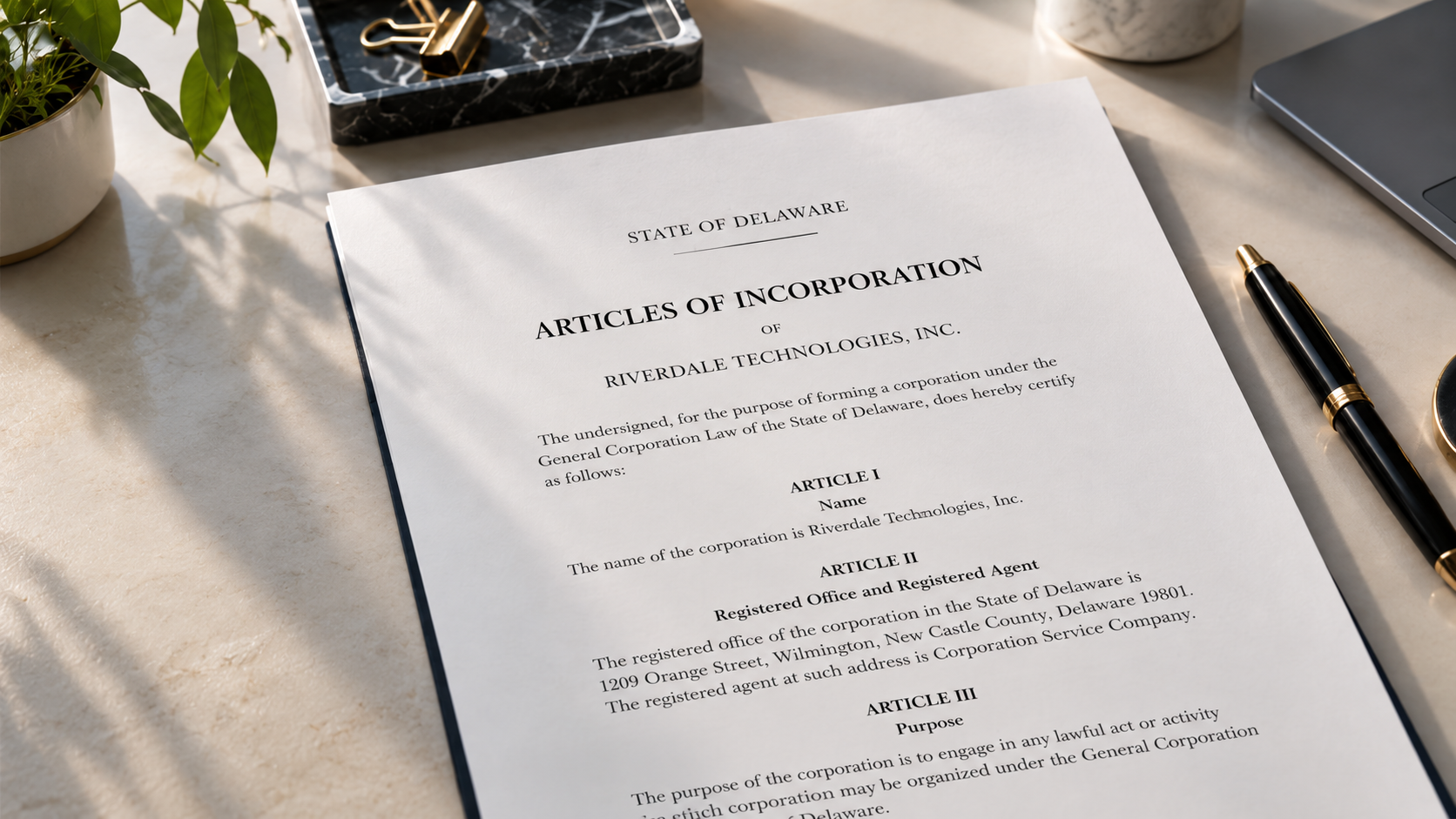
When starting a business, one of the first decisions is where to incorporate. Many entrepreneurs choose to establish their companies in states like Delaware, even when they live and operate their businesses somewhere else.
This is perfectly common in the United States. However, there is an important distinction that business owners sometimes overlook: the state where a company is incorporated is not necessarily the only state where it must be registered.
Understanding the difference can help founders anticipate additional filing requirements, costs, and ongoing obligations.
Why do companies incorporate in Delaware?
Delaware has become one of the most popular states for business incorporation, especially among startups and companies seeking outside investment.
There are several reasons for this:
Established corporate laws: Delaware has a sophisticated and well-developed body of corporate law that provides greater predictability for many business matters.
Specialized business courts: The Delaware Court of Chancery has extensive experience handling corporate disputes.
Investor familiarity: Venture capital firms and institutional investors are familiar with Delaware corporations, making them a common structure for venture-backed startups.
Flexible corporate governance: Delaware law offers flexibility in structuring corporations, including matters involving stockholders, directors, and corporate governance.
These benefits help explain why a company headquartered in Nevada, California, or another state might choose Delaware as its legal home.
But incorporating in Delaware does not automatically eliminate registration obligations elsewhere.
Incorporation vs. doing business: Two different concepts
Incorporation is the legal process of creating a corporation under a particular state's laws.
For example, a corporation established in Delaware is considered a Delaware domestic corporation, even if none of its founders, employees, or customers are located there.
Doing business, on the other hand, generally concerns a company's actual activities and presence within a state.
When a company incorporated in one state conducts business in another, it may need to register in that second state as a foreign corporation.
Despite the terminology, "foreign" in this context does not mean international. It simply means the business was formed under the laws of another jurisdiction.
Example: A Delaware corporation operating in Nevada
Imagine an entrepreneur living in Nevada who decides to incorporate a technology startup in Delaware.
The company is legally formed in Delaware, but its founder manages daily operations from Nevada, works with customers, develops products, and runs the business from a home office.
Although the corporation is incorporated in Delaware, its operations in Nevada may also trigger Nevada's foreign registration requirements.
Under Nevada law, a corporation formed elsewhere generally must qualify with the Nevada Secretary of State before doing business in Nevada. NRS 80.015 lists activities that do not, by themselves, constitute doing business, so the requirement depends on the company’s actual activities.
This may involve:
Filing a foreign corporation registration with Nevada and paying the applicable state fee.
Maintaining a registered agent in Nevada, in addition to the registered agent required in Delaware.
Filing Delaware’s annual report and meeting its franchise tax obligations, while filing Nevada’s annual list of officers and directors and renewing the Nevada state business license unless an exemption applies.
Meeting applicable state and local licensing and tax requirements, and complying with Nevada’s annual-statement newspaper publication requirement for foreign corporations under NRS 80.190.
The company would remain a Delaware corporation. Registering in Nevada would simply authorize it to conduct business there under Nevada's registration framework.
Does living in another state automatically require registration?
Not necessarily.
A founder's personal residence and a company's business activities are not the same thing.
For example, simply owning shares in a Delaware corporation while living in Nevada does not, by itself, mean the corporation is conducting business in Nevada.
Likewise, certain activities, such as maintaining a bank account, holding internal corporate meetings, or conducting particular interstate transactions, may fall within statutory exceptions.
However, regularly managing or conducting company operations from Nevada can raise different considerations.
There is no universal rule that applies to every company. States have their own standards for determining when a foreign business must register, and the answer depends on the company's actual activities.
The cost of maintaining a company in multiple states
Another important consideration is that incorporating outside the state where a business operates can create additional costs.
For example, a Delaware corporation operating in Nevada may have expenses in both jurisdictions:
Delaware | Nevada |
|---|---|
Incorporation filing fee | Foreign registration filing fee |
Delaware registered agent | Nevada registered agent |
Annual report and franchise tax | Annual list, state business license renewal unless exempt, and applicable state taxes |
Other applicable filing requirements | Annual-statement newspaper publication and other applicable licensing requirements |
Registered agent services can create additional annual expenses, although a paid commercial service is not always required.
Delaware corporations generally must file annual reports and pay franchise taxes even when they conduct their business entirely outside Delaware.
Similarly, registering as a foreign corporation in Nevada may introduce additional ongoing requirements. For example, under NRS 80.190, foreign corporations doing business in Nevada must publish an annual statement in a qualifying newspaper, a requirement that does not apply to LLCs. This is one example of how states may impose different obligations depending on the type of entity and where it operates.
State registration requirements and state tax obligations are related but separate. Registering in one state does not necessarily determine every state in which a business has tax obligations.
For a growing company, these costs may be a relatively small part of its overall operations. For an early-stage business, they may be more significant.
Is Delaware incorporation always necessary?
Delaware can provide meaningful advantages, particularly for corporations with complex ownership structures or plans to attract venture capital investment.
However, Delaware incorporation is not a requirement for every startup.
Companies can also incorporate directly in the state where they operate. For example, a business established and operated in Nevada could incorporate in Nevada without needing foreign registration there simply because it operates locally.
The relevant distinction is between the legal benefits of the incorporation jurisdiction and the administrative obligations created by operating in other states.
The bottom line
Where a company is incorporated and where it conducts business are two separate questions.
A company can legally incorporate in Delaware while operating primarily in Nevada or another state. However, incorporating in Delaware does not necessarily remove the need to register in the state where its business activities take place.
Understanding this distinction is an important part of business formation, particularly when evaluating the ongoing costs and requirements associated with operating across state lines.
Official resources
Disclaimer: This article is provided for general educational and informational purposes only. It does not constitute legal or tax advice. Registration requirements depend on the circumstances of each business and the laws of the states involved.